
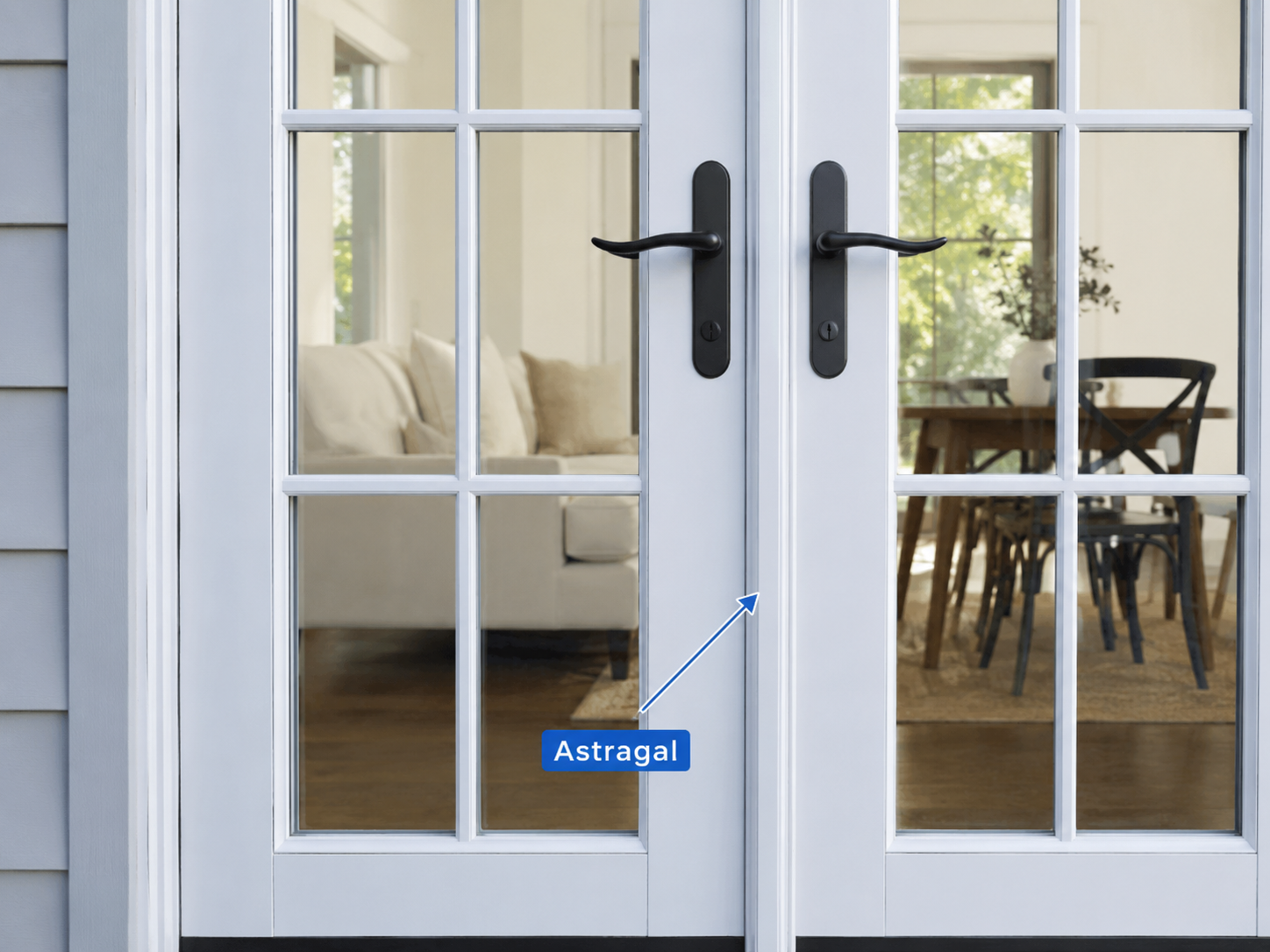
Quick Answer
An astragal is the vertical molding or strip attached to one panel of a pair of French doors that closes the gap where the two doors meet. It houses the flush bolts that lock the inactive panel in place, holds the weatherstripping that seals the center seam, and includes the strike plate where the active door’s deadbolt latches. Without a working astragal, French doors leak air, water, bugs, and energy through the middle of the opening even when both panels look closed.
If your French doors feel drafty in the center, show daylight between the two panels, or move when you push on the inactive side while locked, your astragal is the problem.
Here is what you need to know.
What Does the Astragal Actually Do?
The astragal is the unsung hero of any pair of French doors. Without it, you essentially have two doors that close into empty space and rely entirely on the strike plate to hold things together. With a properly fitted astragal, the two panels behave like a single continuous barrier.
The astragal handles four jobs at once:
- Sealing: Compressible weatherstripping or gaskets attached to the astragal close the gap between the two doors
- Security: Flush bolts at the top and bottom of the inactive door panel slide up into the head jamb and down into the threshold, locking that panel in place
- Locking: A metal strike plate on the astragal body is what your active door’s deadbolt actually catches against
- Drainage: Properly designed astragals direct wind-driven water down and out rather than into your home
In Hampton Roads, Virginia Beach’s highest average relative humidity in the summer between June and August is around 76%, according to multi-decade Virginia Beach climate records, Köppen Cfa classification. With this kind of humidity, a working astragal is critical to keeping French doors functional.
If your French doors are already showing signs of drafts or leaks, our guide on 5 tips for fixing drafty French doors covers other common seal failures you might be dealing with.
What Are the Different Types of Astragals?
There are two main residential designs.
Overlapping astragal (T-astragal)
An overlapping astragal is a single solid piece attached to the inactive door that physically overlaps the edge of the active door. When the active door closes, it presses against gasketing on the astragal to create the seal.
- Pros: Stronger security because the overlap covers the deadbolt area from the exterior side, harder to pry open
- Cons: Forces a closing sequence (the active door must be opened first), requires a door coordinator if both doors are self-closing
- Common on: Most residential French doors, including Andersen Frenchwood patio doors
Split or meeting stile astragal
A split astragal uses two pieces, one attached to each door, that meet in the middle with gaskets that compress together.
- Pros: Both doors can open and close independently in any order
- Cons: Slightly less secure than an overlapping design
- Common on: Some commercial doors and homes where both panels need to be active
How Do I Know If My Astragal Is Failing?
A failing astragal almost always shows up as a draft, a leak, or a security concern. Here are the signs.
- You can see daylight between your closed French doors
- The inactive panel rattles or shifts when you push on it from outside
- Water pools at the threshold during storms
- Bugs find their way through the middle of the closed doors
- The dollar bill test fails: Close the door on a dollar bill at the astragal. If you can pull it out easily, the seal is gone
- The flush bolts don’t engage smoothly at the top or bottom
- The compressible weatherstrip on the astragal looks flattened, cracked, or torn
In Hampton Roads, astragal failure tends to accelerate after about 8 to 10 years of coastal exposure. UV breaks down the weatherstrip, salt air corrodes the slide bolts, and seasonal humidity swings warp the doors enough that the astragal stops mating cleanly with the slab.
Door alignment issues often accompany astragal problems. If your doors are sagging or no longer closing flush, our guide on how to fix uneven French doors walks through the hinge adjustments and shimming techniques that can restore proper alignment.
How Do I Fix a Failing Astragal Myself?
If your French doors are otherwise in good shape, you can often restore proper sealing without replacing the whole unit.
Step 1: Confirm the doors are properly aligned
Before you replace anything, check that the doors that are hanging are square. A warped or sagging door will never seal properly against an astragal, no matter how new the weatherstripping is. Look for an even gap between each panel and the frame all the way around. Adjust the hinges if needed.
Step 2: Replace the astragal weatherstrip
If the astragal body itself is solid but the gasket is shot, you can usually buy a replacement gasket from the door manufacturer. For most kerf-style astragals, you pull out the old gasket and press the new one into the channel. No adhesive required.
Order weatherstripping made for your specific door brand. A universal gasket usually doesn’t seal correctly with most major brands.
Step 3: Check the flush bolt boots
The “boots” at the top and bottom of the astragal include small foam or rubber pads that seal the gap between the slide bolt and the head jamb or threshold. These wear out and let water and air in. Replace them when you replace the gasket.
Step 4: Install or adjust the corner wedge pad
Most exterior French doors require a small triangular wedge pad on top of the threshold, directly behind the astragal weatherseal at the bottom. This pad bridges the corner where the threshold meets the door bottom, which is one of the most common leak points.
If your door is missing this pad or it has crumbled, install a new one before testing the seal.
Step 5: Re-test with the dollar bill
After you’ve replaced the gasket and the boots, close the door on a dollar bill at several points along the astragal. You should feel firm resistance when you try to pull it out. If you don’t, the gap is still too wide and you may need to adjust the hinges or replace the astragal body itself.
When Should You Replace the Whole Astragal?
If the astragal body is bent, split, corroded, or no longer holding its shape, gasket replacement won’t fix the problem. This happens most often when the slide bolt has split the wood around its mortise, or when an aluminum astragal has corroded from salt exposure.
Replacement astragals are available from most door manufacturers as a single full-height unit, typically in 79-inch, 80-inch, 95-inch, or 96-inch standard heights. The new astragal slips into the same mounting holes on the inactive door panel, and most homeowners can complete the swap in 1 to 2 hours.
If the door slab itself has warped, the frame has shifted, or the threshold is rotting, replacing just the astragal won’t fix it. At that point, full door replacement is the better investment. Learn more about patio and entry door options in Hampton Roads.
How Does the Coastal Climate Affect French Door Astragals?
Hampton Roads is unusually hard on French doors. Three factors accelerate astragal failure here:
- Salt air corrodes metal slide bolts and strike plates faster than in inland Virginia
- High humidity from late spring through early fall swells wood astragals, and weatherstripping cycles between wet and dry, breaking down adhesives
- Wind-driven rain from summer storms and the occasional hurricane pushes water sideways into the astragal seam at high pressure
Fibrex composite French doors from Renewal by Andersen avoid most of these problems. The composite frame doesn’t swell, the astragal is factory-fit with marine-grade hardware, and the weatherstrip is precision-set rather than field-installed.
Planning a French Door Replacement Project?
If you’re considering full door replacement, our guide on determining double French door rough opening size explains how to measure correctly for new installation. For minor glass damage that doesn’t require full door replacement, see our article on how to replace a broken glass pane in French doors.
Frequently Asked Questions
Where exactly is the astragal located?
On a standard pair of inswing French doors, the astragal is mounted on the inactive door panel (the one that stays closed most of the time). It runs the full vertical height of the door and overlaps the edge of the active panel when closed.
Can I install an astragal on French doors that don’t have one?
You can retrofit an astragal kit, but the install requires precise measurement and routing for the slide bolts. Most homeowners who try this find the doors don’t seal much better afterward because the underlying alignment issues are still there. Professional installation is usually worth it.
What size astragal do I need?
Astragals come in standard heights of 79 inches, 80 inches, 95 inches, and 96 inches. Measure the full height of your door panel from the threshold to the top of the slab. Cut to fit if the standard sizes are slightly long, but never splice a shorter astragal to make it fit.
Why is my new astragal weatherstrip making the door hard to close?
A new gasket compresses to its design height only after a few weeks of use. If the door is significantly harder to close, the gasket is too thick for your door spacing. Try a thinner profile or adjust the hinges to widen the closing space slightly.
Will a new astragal solve my draft problem permanently?
Often yes, but only if the rest of the door is in good condition. If the perimeter weatherstrip, threshold seal, or door alignment are also failing, you need to address all of them together.
Need Help with a Failing French Door in Hampton Roads?
If your French doors have been leaking air, water, or pests for more than a season, the astragal is rarely the only problem. Mr. Rogers Windows offers free, no-obligation consultations to assess whether a repair, weatherstripping refresh, or full door replacement is the right move for your home.
Get A Free Consultation
Learn more about our patio and entry door services in Virginia Beach.
Mr. Rogers Windows |📍2100 Scenic Parkway, Suite 101, Chesapeake, VA 23323 | 📞 (757) 512-6242 | 🕐 Monday – Friday: 8:30am – 5:00pm | Saturday – Sunday: Closed
Mr. Rogers Windows and Doors is Hampton Roads’ exclusive source for Renewal by Andersen replacement windows and patio doors, including Frenchwood French door systems engineered for coastal conditions. Serving the Greater Hampton Roads and North Eastern North Carolina area since 1986.