Quick answer: Both Fibrex® and quality vinyl resist salt corrosion, because neither contains metal in the frame. The real difference in coastal Virginia is dimensional stability. Fibrex® , a composite of roughly 40% reclaimed wood fiber and 60% thermoplastic polymer, expands and contracts less than vinyl under the temperature swings and direct sun that Hampton Roads delivers, which is what keeps seals and corners tight over decades.
If you have gotten more than one quote in Virginia Beach or Norfolk, you have probably heard two competing pitches. One says vinyl is the smart coastal choice because salt cannot corrode it. The other says composite is worth the premium. Both are selling something. Here is the version with the caveats left in.
Does salt air actually damage window frames?
Salt air is brutal on metal and it is largely irrelevant to plastic. Aluminum frames pit and corrode near the water. Metal hardware, balances, and fasteners are the real casualties, which is why hardware quality matters more within a mile of the Chesapeake Bay than it does in Richmond.
Neither vinyl nor Fibrex® corrodes. Anyone claiming their vinyl uniquely defeats salt is describing a property that every non-metallic frame shares. The differentiator in Tidewater is not corrosion. It is heat, humidity, and UV.
What is Fibrex® made of?
Fibrex® is Andersen’s proprietary composite, approximately 40% reclaimed wood fiber and 60% thermoplastic polymer by weight, perfected in 1992. Andersen markets it as twice as strong as vinyl, and it blocks thermal transfer roughly 700 times better than aluminum.
The wood fiber is what changes the behavior. Adding cellulose to a polymer reduces how much the material moves when it heats up. That matters on a south-facing Sandbridge elevation in August far more than it does in a shaded northern climate.
How do the two materials compare?
| Factor | Fibrex® composite | Quality vinyl |
|---|---|---|
| Salt corrosion | Does not corrode | Does not corrode |
| Typical service life | 30+ years | 20 to 40 years |
| Thermal movement | Lower, wood fiber restrains expansion | Higher, especially in dark colors |
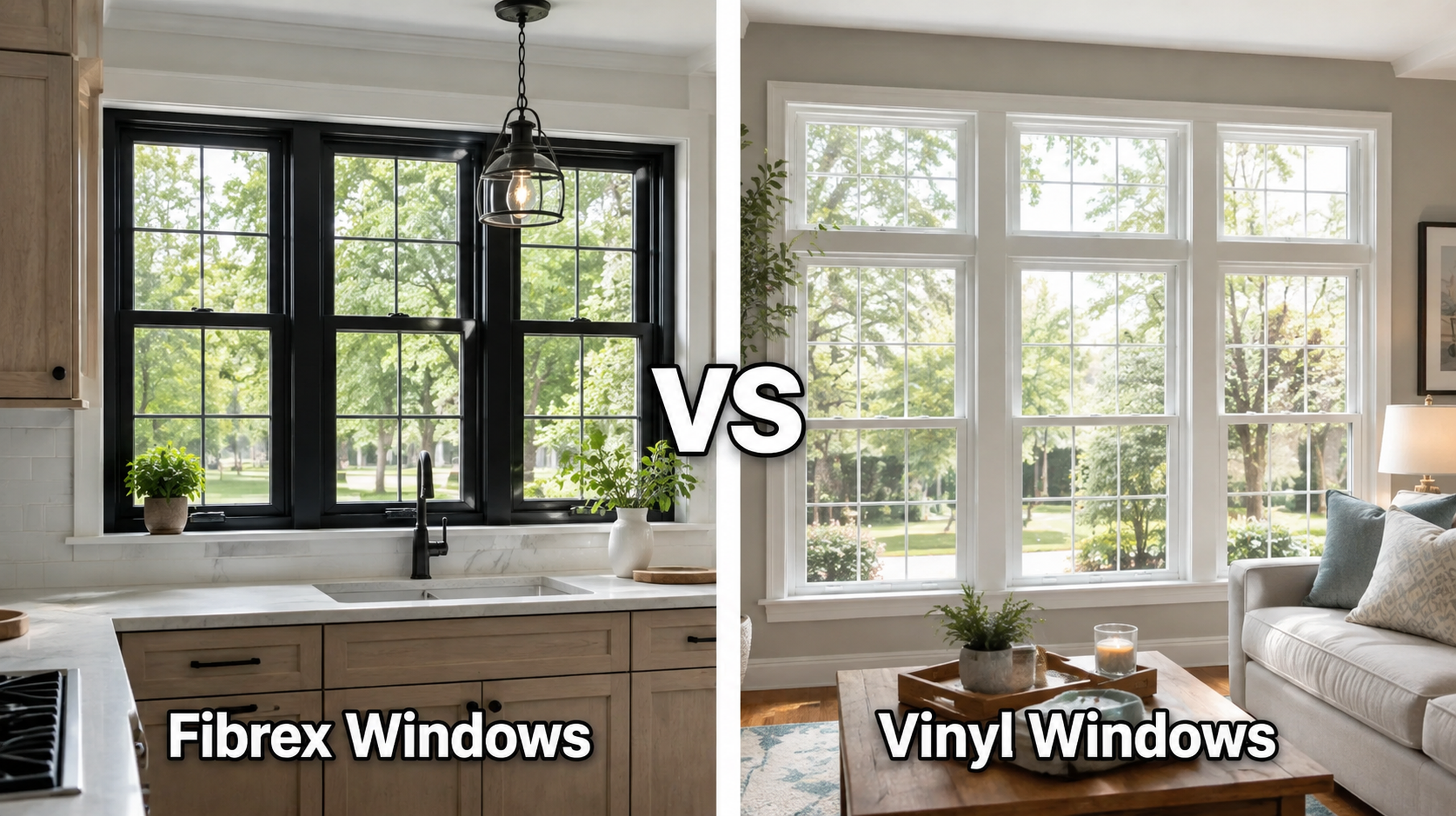
| Frame profile | Narrower for the same opening, more glass | Wider, bulkier sightlines |
| Dark exterior colors | Holds color, warranted not to fade, flake, blister, or peel | Can warp or fade in dark finishes under direct sun |
| Installed cost per window | $1,500 to $5,000 | $400 to $1,400 |
| Energy performance | Driven mostly by the glass package | Driven mostly by the glass package |
Where is the honest case for vinyl?
We would rather say this out loud than have you find it on a forum. Good vinyl is a legitimate product. If your budget is $10,000 rather than $30,000, a quality vinyl window with a strong glass package will outperform doing nothing by a wide margin, and it will not corrode at the beach. Homeowners on DIY forums regularly point out that Fibrex® does not magically produce better energy numbers than the alternatives, and they are right. The energy performance comes mostly from the glass.
What you are paying extra for with Fibrex® is longevity of the frame itself, narrower sightlines, color stability, and in our case the installation crew and warranty behind it. If those things do not matter to your situation, they do not matter.
What does the durability testing actually show?
Andersen’s long-running study placed Fibrex® units in Minnesota exposure conditions and reported that after 30 years the material still withstood 150°F and remained about twice as strong as vinyl, without cracking, rotting, pitting, corroding, flaking, blistering, or peeling. It is a manufacturer study, so weigh it accordingly, but the sample has now been in the weather longer than most vinyl windows on Hampton Roads homes have existed.
Which should you choose for a Hampton Roads home?
A practical way to decide:
– Staying long-term, especially near the water: composite is the better durability bet.
– Selling or relocating within a few years: mid-range vinyl is defensible and the resale recovery is comparable.
– You want dark exterior colors: lean composite. Dark vinyl in full southern exposure is where problems show up.
– Your priority is the energy bill: spend the money on the glass package before you spend it on the frame.
Whichever way you go, verify the design pressure rating for your address and confirm whether your parcel sits in a wind-borne debris region. That decision affects performance in a coastal storm far more than the frame material debate does. Details are on our coastal impact windows page.
Frequently asked questions
Is Fibrex® better than vinyl?
Fibrex® is stronger and more dimensionally stable, with roughly 40% reclaimed wood fiber restraining thermal movement, and it supports narrower frames and dark colors better. Quality vinyl is significantly less expensive and also resists salt. Neither material determines energy efficiency on its own, since that comes primarily from the glass package.
Do vinyl windows hold up in salt air?
Yes. Vinyl does not corrode in salt air. The components most vulnerable near the coast are metal hardware, balances, and fasteners, so hardware quality and corrosion-resistant finishes matter more than the frame material itself.
How long do Fibrex® windows last?
Andersen reports 30-plus years based on long-term exposure testing. Renewal by Andersen covers glass and Fibrex® components for 20 years, hardware for 10 years, and installation labor for 2 years, with 10 years on coastal impact glass.
Will dark-colored window frames fade in the Virginia Beach sun?
Fibrex® is warranted not to fade, flake, blister, or peel. Dark vinyl is the higher-risk choice in full southern exposure because vinyl expands more with heat, which can affect both color and frame geometry over time.
Does Fibrex cost more than vinyl?
Yes, meaningfully. Fibrex® windows through Renewal by Andersen generally run $1,500 to $5,000 per window installed, compared with roughly $400 to $1,400 for builder-grade and mid-range vinyl. Much of that gap reflects the full-service installation model rather than the material alone.
Is Fibrex® the same material Andersen uses in the 100 Series?
Yes. Andersen’s 100 Series uses the same Fibrex® composite. The difference between that product and a Renewal by Andersen installation is the service model, the custom sizing, and the single-source warranty, not the frame material.
Not sure which is right for your house? We will look at your exposure, your hardware, and your actual openings before recommending anything. Book a free in-home consultation with Mr. Rogers Windows & Doors, serving Virginia Beach, Norfolk, and all of Hampton Roads for over 40 years. Learn more about the Fibrex® difference or browse energy efficient window options.
*Last updated: July 2026.
Mr. Rogers Windows
📍 2100 Scenic Parkway, Suite 101, Chesapeake, VA 23323
📞 (757) 512-6242
🕐 Monday – Friday: 8:30am – 5:00pm | Saturday – Sunday: Closed
In Your Free In-Home Consultation: Discuss your needs and priorities. See samples of all door styles. Review color and customization options. Get precise measurements. Receive a detailed quote valid for one full year. No pressure, no obligation.
Mr. Rogers Windows and Doors is Hampton Roads’ exclusive source for Renewal by Andersen replacement windows and patio doors. Serving Virginia Beach, Norfolk, Chesapeake, Suffolk, Newport News, Hampton, Portsmouth, Yorktown, Williamsburg, Smithfield, Gloucester, Elizabeth City, Moyock, the Outer Banks, and surrounding communities since 1986.